

New World / Cybervikings of Mars
 ©EP2024
Līga Spunde is one of Latvia’s most prominent digital artists, creating works that range from video and digital print to sculpture, assemblage and installations. While her primary sources of inspiration are her personal experiences and emotions, she often intertwines the personal with fictional elements, in order to create new visual languages and advance her practice. In her own words, ‘the most exciting thing about being a multidisciplinary artist is the opportunity to always try something new, to do something you’ve never done before’.
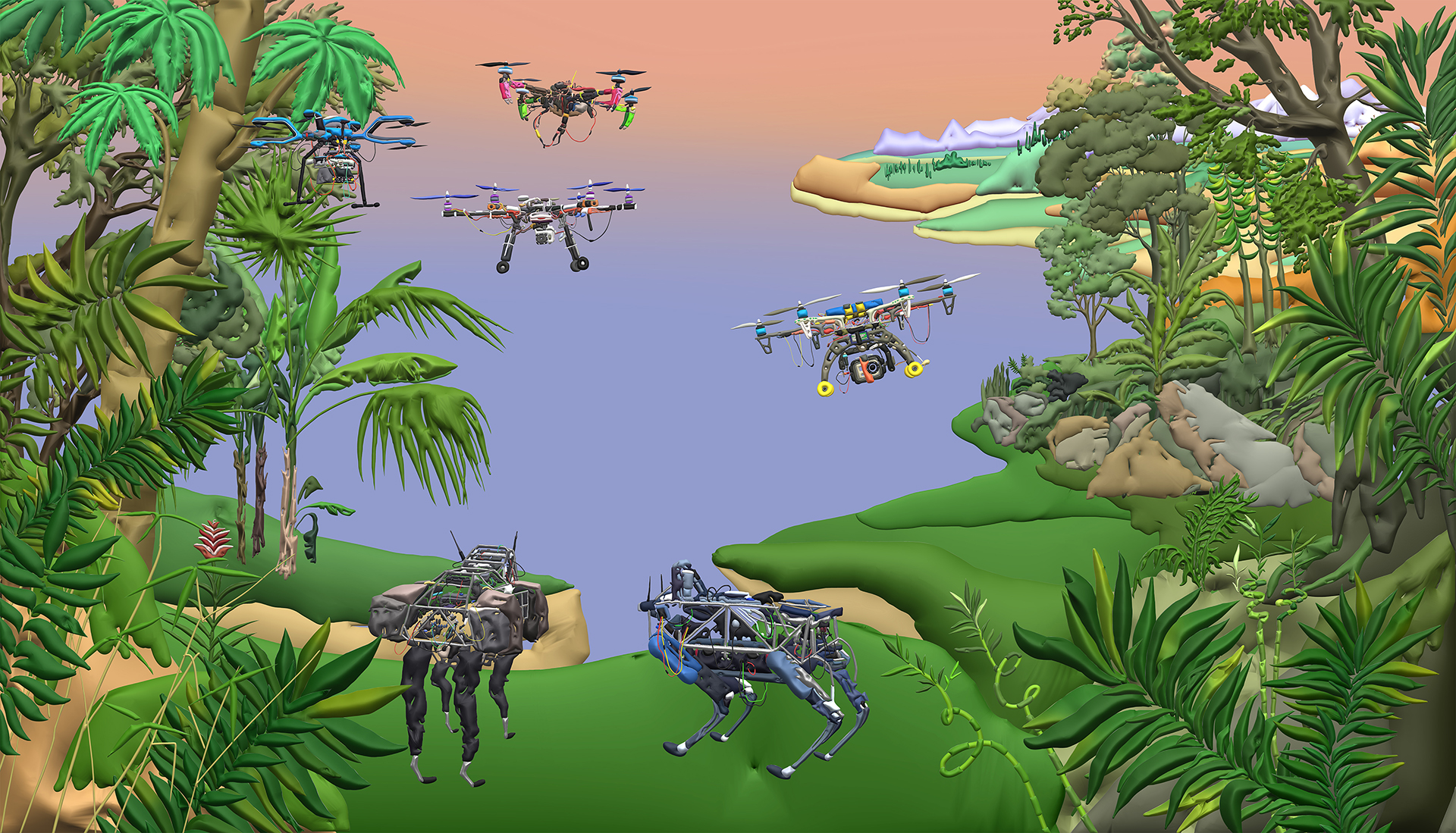
‘New World / Cybervikings of Mars’ is a digital graphic work that carries the signature style and aesthetic of the artist: a blend of retro elements and futurism. In the composition, rendered in the visual style of old-fashioned videogames, drones and animal-like cyborgs are depicted in a digitally rendered natural environment, undefined and vague as to where it could be located. The image deals with popular topics such as the influence of social media networks, the uncertainties posed by rapid technological advancements, and the conquest and colonisation of alternative territories, such as outer space and cyberspace. The artist approaches these topics, which hold prominent positions on the current international political agenda, with a sense of humour, and rich imagery saturated with colours and references to culture and pop culture.
The second part of the title of the artwork, ‘Cybervikings of Mars’, is a play on a tweet by Elon Musk that went viral. As with many of Musk’s tweets, it caused an immediate response from followers, who created digital products such as non-fungible tokens in the hope of making a profit. It also prompted discussions about the real meaning behind that tweet. The work addresses the modern trend of exploitation without boundaries, and uncovering and conquering new physical and digital territories at any cost – especially human or environmental. It also hints at FOMO, the collective fear of missing out on opportunities, an experience intensified by social media in the last decade, resulting from the anxiety provoked by endless possibilities that must be always available to us.
More artists from the following country:
Latvia

New World / Cybervikings of Mars
Līga SPUNDEClick on the coloured dots and discover the european historical context
Browse the calendar and discover the european historical context
- 2015
- 2016
- 2017
- 2018
- 2019
- 2020
- 2021
- 2022
- 2023
- 2024
- 2025
- 2026
- 2027
- 2028
- 2029
- 2030
- 2031
- 2032
- 2033
- 2034
- 2035
-
2016
Brexit referendum
UK voters decide to support leaving the European Union in a closely-fought referendum called by UK Prime Minister David Cameron. The outcome of the referendum triggers the resignation of Cameron. His successor Theresa May pledges to take the UK out of the EU and initiates the process on 29 March 2017.
-
2017
Antonio Tajani
Antonio Tajani served as President of the European Parliament from 2017 to 2019.
-
2019
David Sassoli
David Sassoli served as President of the European Parliament from 2019 to 2022.
Value of culture
(…) the intrinsic value of culture and of artistic expression should always be preserved and promoted and that artistic creation is at the heart of cooperation projects. European Parliament legislative resolution of 28 March 2019 on the proposal for a regulation of the European Parliament and of the Council establishing the Creative Europe programme (2021 to 2027) and repealing Regulation (EU) No 1295/2013 (COM(2018)0366 – C8 0237/2018 – 2018/0190(COD))
2019 European elections
The European elections in May 2019 see about 51% of EU voters go to the polls, the highest turnout in 20 years. The centre-right European People’s Party and centre-left Social Democrats lose seats but remain the two largest groups in Parliament, while other centrist and liberal parties make gains.
-
2020
Brexit
After the European Parliament ratified the withdrawal agreement on 29 January, the UK leaves the EU about three and a half years after voters supported the move in a referendum.
As of 1 February, the number of EU member states is 27 and the term of office of UK MEPs ends. The number of MEPs is 705 (previously 751), as some of the UK seats are allocated to existing member states to reflect demographic changes, while others are kept in reserve for when another country joins the EU.
-
2021
Acquisition programme of works of art from Germany, Poland, Spain and Sweden following the Bureau decision from 25 November 2019
-
2022
European Year of Youth 2022
2022 is the European Year of Youth! A perfect opportunity to highlight the European youth’s important role in shaping a greener, more inclusive and digital future.
Acquisition programme of works of art from Czechia, Italy, Malta and Slovakia following the Bureau decision from 25 November 2019
Roberta Metsola
Roberta Metsola serves as President of the European Parliament since January 2022
-
2023
Croatia joins the euro area
Croatia is the 20th country to join the euro area, replacing the kuna with the euro as its currency. In order to be part of the euro area, a country has to fulfill a set of economic conditions, which include having a stable exchange rate and a low inflation rate. Seven EU countries still use their national currencies: Bulgaria, Czechia, Denmark, Hungary, Poland, Romania, and Sweden.
Acquisition programme of works of art from Cyprus, Estonia, Malta, Romania and The Netherlands following the Bureau decision from 25 November 2019
-
2024
Acquisition programme of works of art from Austria, Bulgaria, Croatia and Finland following the Bureau decision from 25 November 2019
European elections
The 2024 European Parliament election took place from 6 to 9 June 2024. This was the tenth parliamentary election since the first direct elections in 1979, and the first European Parliament election after Brexit.
-
2025
Acquisition programme of works of art from Denmark, Latvia and Slovenia following the Bureau decision from 25 November 2019