

Topoli
 ©EP2026
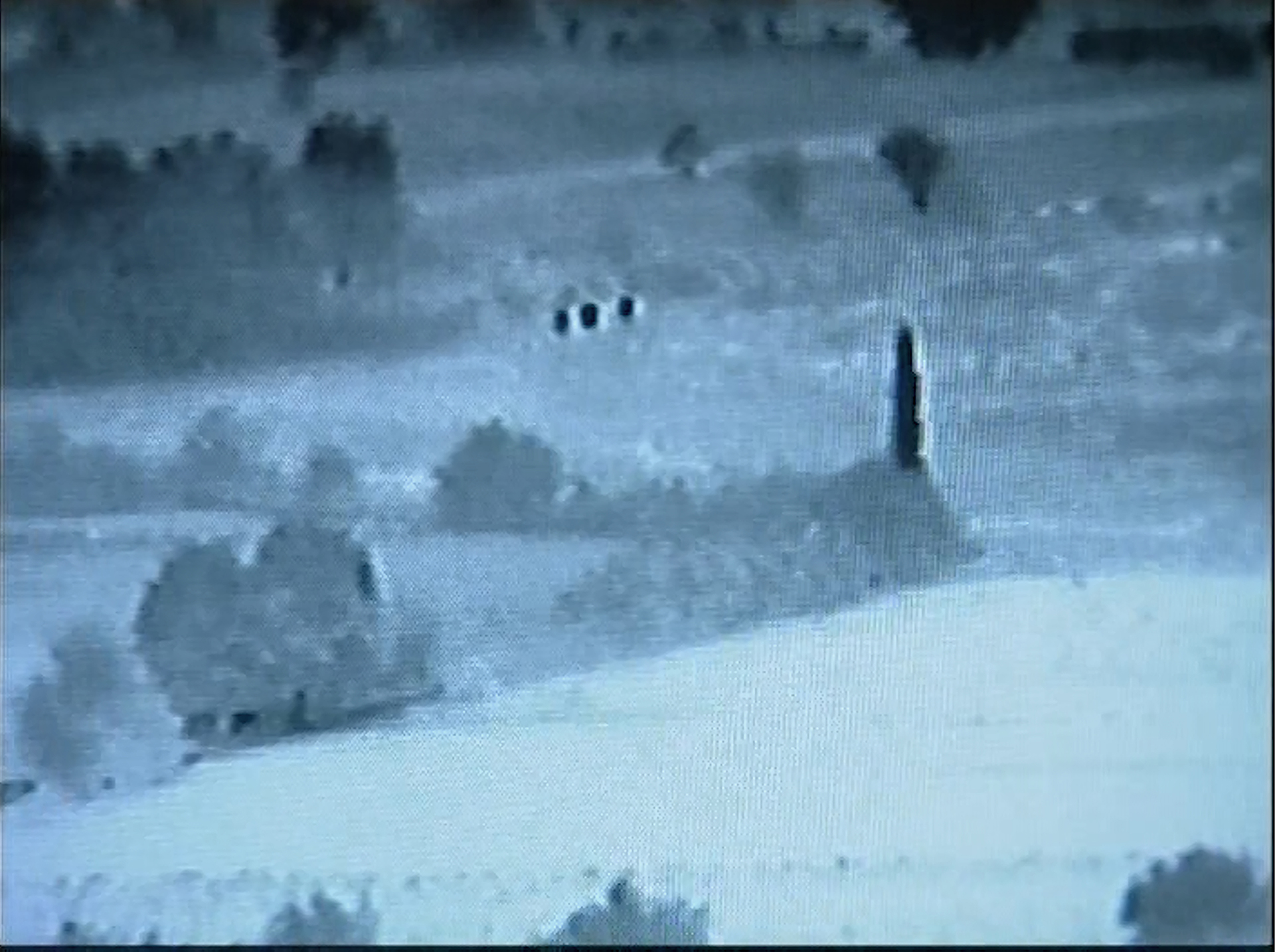
Breze v jeseni, Topoli and Macesen are images from the photo series ‘Impressions’ created in 2010 by Slovenian visual artist Nika Autor, whose work explores asylum and migration policies, workers’ rights and the politics of memory. In keeping with the artist’s practice, these images reconstruct collective memory and personal narratives, and explore the ‘silenced’ present. They also reflect a considerable part of her artistic trajectory, which has been characterised by experimental videos and documentaries.
These images are stills from footage, belonging to the video archives of Radio Televizija Slovenija (Radio-Television Slovenia), which was captured by police thermographic cameras used for territory surveillance on Slovenia’s borders. Presenting them outside of that context, with new titles, Autor aims to demonstrate how such images contribute to the criminalisation and victimisation of refugees and migrants.
In this context, this type of police photography depicts human presence as a disturbance, producing new images of the living environment but also setting the boundaries of a discourse on illegality. Through the resulting images, the artist weaves layers of meaning, exploring what movement means in terms of nation-states, and how it connects with the realities of border violence and non-belonging. The stills of these individuals as shapeless and nameless beings not only serve to criminalise them, but also actively and specifically identify them as ‘other’.
Each of the artworks in Autor’s series turns the natural landscape into scenes of challenging, dehumanising rhetoric around migration, and in doing so, she explores the contrast between the migrant situation and the idealised landscape motifs of impressionism. The images Breze v jeseni, Topoli and Macesen are similar to impressionist paintings. Indeed, they carry the names of famous Slovenian impressionist paintings by Rihard Jakopič and Ivan Grohar.
Through this photo series, Autor re-stages idealised depictions of the Slovenian landscape. Through this re-staging and the newly ‘disturbed’ landscape, Autor provides a social commentary on the violence, which is inscribed in the visible boundaries between ‘us’ and ‘them’. Her work holds a mirror up to society and highlights the way in which dominant narratives can manipulate the perceptions of space and its relationship with the human condition.
From the same artist


More artists from the following country:
Slovenia

Topoli
Nika AUTORClick on the coloured dots and discover the european historical context
Browse the calendar and discover the european historical context
- 2015
- 2016
- 2017
- 2018
- 2019
- 2020
- 2021
- 2022
- 2023
- 2024
- 2025
- 2026
- 2027
- 2028
- 2029
- 2030
- 2031
- 2032
- 2033
- 2034
- 2035
-
2016
Brexit referendum
UK voters decide to support leaving the European Union in a closely-fought referendum called by UK Prime Minister David Cameron. The outcome of the referendum triggers the resignation of Cameron. His successor Theresa May pledges to take the UK out of the EU and initiates the process on 29 March 2017.
-
2017
Antonio Tajani
Antonio Tajani served as President of the European Parliament from 2017 to 2019.
-
2019
David Sassoli
David Sassoli served as President of the European Parliament from 2019 to 2022.
Value of culture
(…) the intrinsic value of culture and of artistic expression should always be preserved and promoted and that artistic creation is at the heart of cooperation projects. European Parliament legislative resolution of 28 March 2019 on the proposal for a regulation of the European Parliament and of the Council establishing the Creative Europe programme (2021 to 2027) and repealing Regulation (EU) No 1295/2013 (COM(2018)0366 – C8 0237/2018 – 2018/0190(COD))
2019 European elections
The European elections in May 2019 see about 51% of EU voters go to the polls, the highest turnout in 20 years. The centre-right European People’s Party and centre-left Social Democrats lose seats but remain the two largest groups in Parliament, while other centrist and liberal parties make gains.
-
2020
Brexit
After the European Parliament ratified the withdrawal agreement on 29 January, the UK leaves the EU about three and a half years after voters supported the move in a referendum.
As of 1 February, the number of EU member states is 27 and the term of office of UK MEPs ends. The number of MEPs is 705 (previously 751), as some of the UK seats are allocated to existing member states to reflect demographic changes, while others are kept in reserve for when another country joins the EU.
-
2021
Acquisition programme of works of art from Germany, Poland, Spain and Sweden following the Bureau decision from 25 November 2019
-
2022
European Year of Youth 2022
2022 is the European Year of Youth! A perfect opportunity to highlight the European youth’s important role in shaping a greener, more inclusive and digital future.
Acquisition programme of works of art from Czechia, Italy, Malta and Slovakia following the Bureau decision from 25 November 2019
Roberta Metsola
Roberta Metsola serves as President of the European Parliament since January 2022
-
2023
Croatia joins the euro area
Croatia is the 20th country to join the euro area, replacing the kuna with the euro as its currency. In order to be part of the euro area, a country has to fulfill a set of economic conditions, which include having a stable exchange rate and a low inflation rate. Seven EU countries still use their national currencies: Bulgaria, Czechia, Denmark, Hungary, Poland, Romania, and Sweden.
Acquisition programme of works of art from Cyprus, Estonia, Malta, Romania and The Netherlands following the Bureau decision from 25 November 2019
-
2024
Acquisition programme of works of art from Austria, Bulgaria, Croatia and Finland following the Bureau decision from 25 November 2019
European elections
The 2024 European Parliament election took place from 6 to 9 June 2024. This was the tenth parliamentary election since the first direct elections in 1979, and the first European Parliament election after Brexit.
-
2025
Acquisition programme of works of art from Denmark, Latvia and Slovenia following the Bureau decision from 25 November 2019