

Untitled
 ©EP2026
Tove Storch’s work can be viewed as a continuous investigation of sculptural possibilities. The Danish artist bases her art on research, and to a greater extent, on physically perceiving and experiencing, creating sensuous and often unexpected sculptures through which she experiments with different materials, and their relationship with both the viewer and the space around them.
The focus of her sculptural works is the materials: their nature, their limitations and the unexpected ways in which they can be used, reworked and presented to the viewer. She does not seek to overwhelm the audience, but to make them focus on sensations and details – in her own words, to ‘sharpen the view on reality’. As a result, her floor-pieces reflect the space and the viewer, and may function as an exercise in mindfulness, in being present.
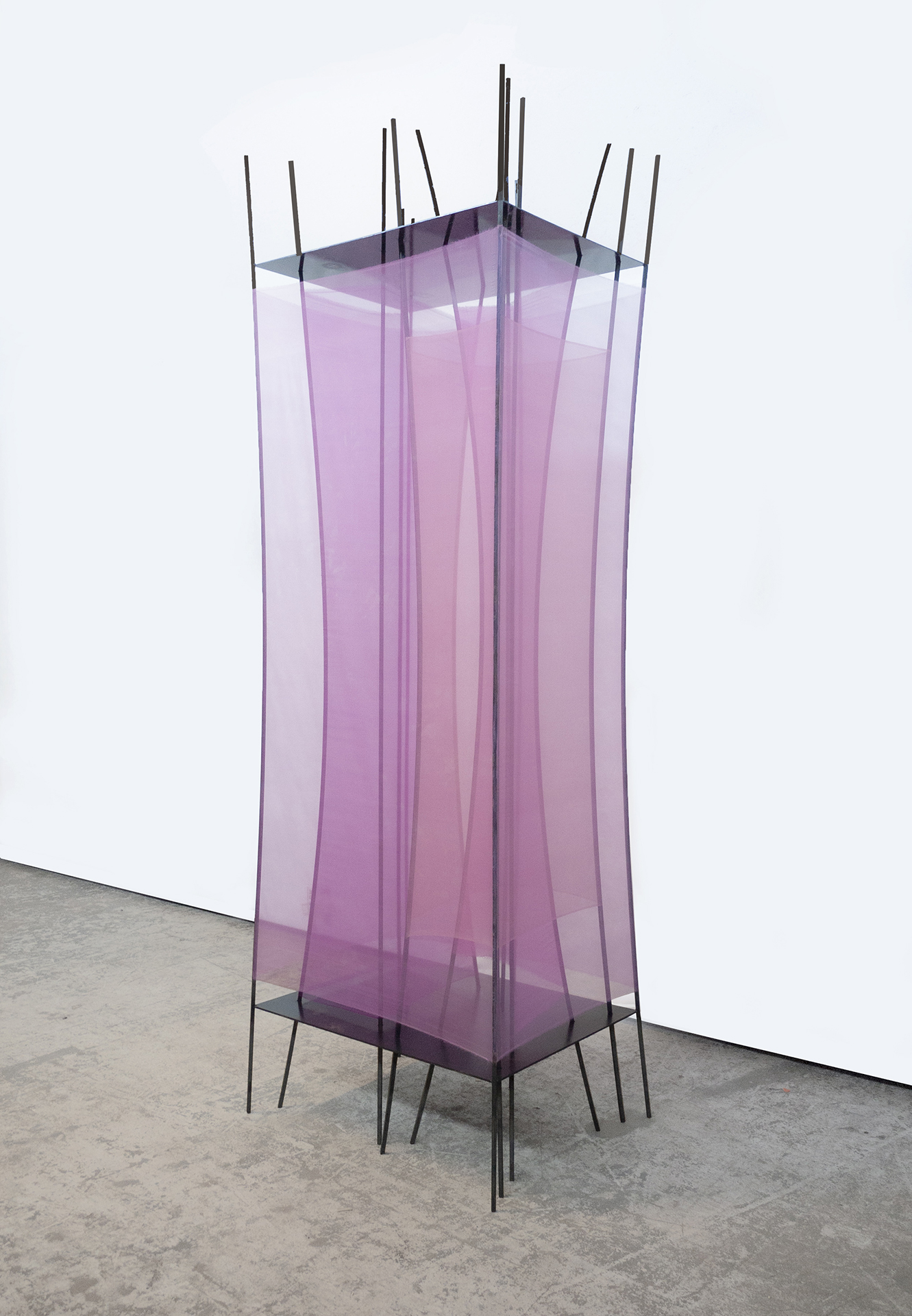
This artwork (Untitled (2022)) is part of a larger project, a whole series of artworks that teeter between sculpture and architecture and use transparent material, mainly a specific kind of silk, to create space. It also belongs to what Storch has identified as her ‘pink period’ – she finds herself obsessing over and working on specific colours for a long time. The colour pink is ultimately connected, for her, to the idea of sensing the body, femininity and sexuality, and finding connections with feminist symbols. Here, the pink translucent silk is reworked and weaved in non-traditional ways by the artist. Stretched across dark metallic surfaces and sticks, it challenges the – on first sight – incompatibility of the materials, creating different views depending on light and positioning, together with a visual dialogue between the two contrasts. This play between softness and hardness is a way for the artist to work the embodiments of, and clash between, femininity and masculinity into the materials and the sculptural techniques, themselves. It is also a way of delving into concepts of love, violence and caregiving. This contradiction not only distances her work from traditional sculpture, but it also enables the materials to construct their own language. This textural and spatial language is very important for Storch, who, in a small act of rebellion, usually names her pieces ‘untitled’ so that the focus can only be on the materials, senses and the experiences they provoke in the viewer, without preconceptions.
More artists from the following country:
Denmark

Untitled
Tove STORCHClick on the coloured dots and discover the european historical context
Browse the calendar and discover the european historical context
- 2015
- 2016
- 2017
- 2018
- 2019
- 2020
- 2021
- 2022
- 2023
- 2024
- 2025
- 2026
- 2027
- 2028
- 2029
- 2030
- 2031
- 2032
- 2033
- 2034
- 2035
-
2016
Brexit referendum
UK voters decide to support leaving the European Union in a closely-fought referendum called by UK Prime Minister David Cameron. The outcome of the referendum triggers the resignation of Cameron. His successor Theresa May pledges to take the UK out of the EU and initiates the process on 29 March 2017.
-
2017
Antonio Tajani
Antonio Tajani served as President of the European Parliament from 2017 to 2019.
-
2019
David Sassoli
David Sassoli served as President of the European Parliament from 2019 to 2022.
Value of culture
(…) the intrinsic value of culture and of artistic expression should always be preserved and promoted and that artistic creation is at the heart of cooperation projects. European Parliament legislative resolution of 28 March 2019 on the proposal for a regulation of the European Parliament and of the Council establishing the Creative Europe programme (2021 to 2027) and repealing Regulation (EU) No 1295/2013 (COM(2018)0366 – C8 0237/2018 – 2018/0190(COD))
2019 European elections
The European elections in May 2019 see about 51% of EU voters go to the polls, the highest turnout in 20 years. The centre-right European People’s Party and centre-left Social Democrats lose seats but remain the two largest groups in Parliament, while other centrist and liberal parties make gains.
-
2020
Brexit
After the European Parliament ratified the withdrawal agreement on 29 January, the UK leaves the EU about three and a half years after voters supported the move in a referendum.
As of 1 February, the number of EU member states is 27 and the term of office of UK MEPs ends. The number of MEPs is 705 (previously 751), as some of the UK seats are allocated to existing member states to reflect demographic changes, while others are kept in reserve for when another country joins the EU.
-
2021
Acquisition programme of works of art from Germany, Poland, Spain and Sweden following the Bureau decision from 25 November 2019
-
2022
European Year of Youth 2022
2022 is the European Year of Youth! A perfect opportunity to highlight the European youth’s important role in shaping a greener, more inclusive and digital future.
Acquisition programme of works of art from Czechia, Italy, Malta and Slovakia following the Bureau decision from 25 November 2019
Roberta Metsola
Roberta Metsola serves as President of the European Parliament since January 2022
-
2023
Croatia joins the euro area
Croatia is the 20th country to join the euro area, replacing the kuna with the euro as its currency. In order to be part of the euro area, a country has to fulfill a set of economic conditions, which include having a stable exchange rate and a low inflation rate. Seven EU countries still use their national currencies: Bulgaria, Czechia, Denmark, Hungary, Poland, Romania, and Sweden.
Acquisition programme of works of art from Cyprus, Estonia, Malta, Romania and The Netherlands following the Bureau decision from 25 November 2019
-
2024
Acquisition programme of works of art from Austria, Bulgaria, Croatia and Finland following the Bureau decision from 25 November 2019
European elections
The 2024 European Parliament election took place from 6 to 9 June 2024. This was the tenth parliamentary election since the first direct elections in 1979, and the first European Parliament election after Brexit.
-
2025
Acquisition programme of works of art from Denmark, Latvia and Slovenia following the Bureau decision from 25 November 2019