

Whip It Good
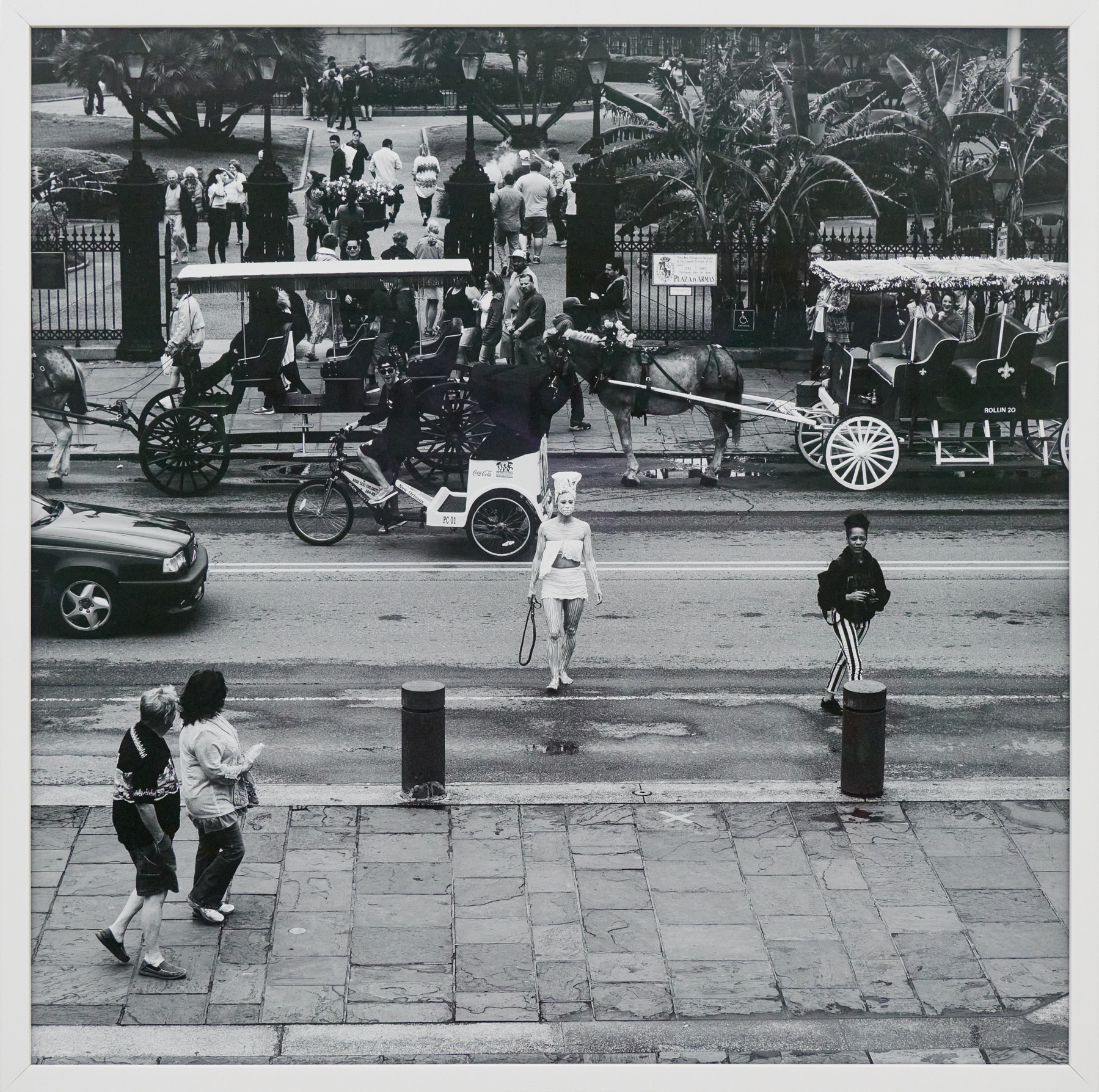 Photo by Kim Coleman_Bjarke Johansen
Jeannette Ehlers is a prominent Danish-Trinidadian artist based in Copenhagen, well established in both the Danish and international contemporary art scenes. Her practice includes experiments across photography, video, installation, sculpture and performance, often addressing questions around memory, race and colonialism using a transnational lens and in a way that is relevant to the broader black diaspora.
Whip It Good is a photographic piece connected to a performance, by the same name, based on whipping, one of the brutal punishment methods used during slavery. Whip It Good was first performed in Berlin at BE.BOP in 2013 and it has since travelled worldwide. This photographic still is from a performance in New Orleans in 2016.
In the actual performance, the artist transforms the whip, rubbed with black charcoal, into a paintbrush, which is hit against a white canvas in a rhythmic and ritualistic gesture – first in the hands of the artist, and later offered to the participants. The ritual enacts the brutality of the transatlantic slave trade, while also transforming the body and the canvas into a series of questions and symbols.
The powerful image of Whip It Good is Ehlers’s attempt to critically reimagine and challenge racist systems of power and domination in everyday settings of urban and social environments, and is connected to the tradition of what Uri McMillan theorised as ‘performing objecthood’. This tradition, used by many artists of colour since the 1970s, focuses on the use of the racialised body by the artist both as a means of social critique and as an artistic agent and subject.
More artists from the following country:
Denmark

Whip It Good
Jeannette EHLERSClick on the coloured dots and discover the european historical context
Browse the calendar and discover the european historical context
- 2015
- 2016
- 2017
- 2018
- 2019
- 2020
- 2021
- 2022
- 2023
- 2024
- 2025
- 2026
- 2027
- 2028
- 2029
- 2030
- 2031
- 2032
- 2033
- 2034
- 2035
-
2016
Brexit referendum
UK voters decide to support leaving the European Union in a closely-fought referendum called by UK Prime Minister David Cameron. The outcome of the referendum triggers the resignation of Cameron. His successor Theresa May pledges to take the UK out of the EU and initiates the process on 29 March 2017.
-
2017
Antonio Tajani
Antonio Tajani served as President of the European Parliament from 2017 to 2019.
-
2019
David Sassoli
David Sassoli served as President of the European Parliament from 2019 to 2022.
Value of culture
(…) the intrinsic value of culture and of artistic expression should always be preserved and promoted and that artistic creation is at the heart of cooperation projects. European Parliament legislative resolution of 28 March 2019 on the proposal for a regulation of the European Parliament and of the Council establishing the Creative Europe programme (2021 to 2027) and repealing Regulation (EU) No 1295/2013 (COM(2018)0366 – C8 0237/2018 – 2018/0190(COD))
2019 European elections
The European elections in May 2019 see about 51% of EU voters go to the polls, the highest turnout in 20 years. The centre-right European People’s Party and centre-left Social Democrats lose seats but remain the two largest groups in Parliament, while other centrist and liberal parties make gains.
-
2020
Brexit
After the European Parliament ratified the withdrawal agreement on 29 January, the UK leaves the EU about three and a half years after voters supported the move in a referendum.
As of 1 February, the number of EU member states is 27 and the term of office of UK MEPs ends. The number of MEPs is 705 (previously 751), as some of the UK seats are allocated to existing member states to reflect demographic changes, while others are kept in reserve for when another country joins the EU.
-
2021
Acquisition programme of works of art from Germany, Poland, Spain and Sweden following the Bureau decision from 25 November 2019
-
2022
European Year of Youth 2022
2022 is the European Year of Youth! A perfect opportunity to highlight the European youth’s important role in shaping a greener, more inclusive and digital future.
Acquisition programme of works of art from Czechia, Italy, Malta and Slovakia following the Bureau decision from 25 November 2019
Roberta Metsola
Roberta Metsola serves as President of the European Parliament since January 2022
-
2023
Croatia joins the euro area
Croatia is the 20th country to join the euro area, replacing the kuna with the euro as its currency. In order to be part of the euro area, a country has to fulfill a set of economic conditions, which include having a stable exchange rate and a low inflation rate. Seven EU countries still use their national currencies: Bulgaria, Czechia, Denmark, Hungary, Poland, Romania, and Sweden.
Acquisition programme of works of art from Cyprus, Estonia, Malta, Romania and The Netherlands following the Bureau decision from 25 November 2019
-
2024
Acquisition programme of works of art from Austria, Bulgaria, Croatia and Finland following the Bureau decision from 25 November 2019
European elections
The 2024 European Parliament election took place from 6 to 9 June 2024. This was the tenth parliamentary election since the first direct elections in 1979, and the first European Parliament election after Brexit.
-
2025
Acquisition programme of works of art from Denmark, Latvia and Slovenia following the Bureau decision from 25 November 2019