

Claudy JONGSTRA
Claudy Jongstra’s monumental creations and architectural installations in felted wool have garnered worldwide fame. Her oeuvre harmonises the aesthetic pursuit with an activist approach, which supports sustainability, biodiversity, and ecology, while working towards community building, inclusivity and the preservation of heritage. Jongstra’s creative practice and vision could be described as holistic, since the artist conceives her works within a sustainable chain of production, from sourcing the materials to the completion of the manufacturing process, culminating with the art piece. In the rural landscape of Friesland in the Netherlands, the artist maintains a rare breed of indigenous Drenthe Heath sheep and cultivates a biodynamic botanical garden; these provide the raw materials for her artworks. The Jongstra uses these in a highly original manner, reviving and innovating the ancient crafts of wool felting and the production of natural dyes. The plants from the specialised botanical garden are distilled into natural pigments and applied to raw wool in the research laboratory. The artist uses these unique natural colours and textures to compose powerful, large-scale artworks and extraordinary installations.
Colour is a passion and a project for Claudy Jongstra, about which she talks in the short film below, “The Gift of Colour”, a collaboration with Extended Ground, the Municipality of Amsterdam, and the secondary vocational education institution ROC TOP.
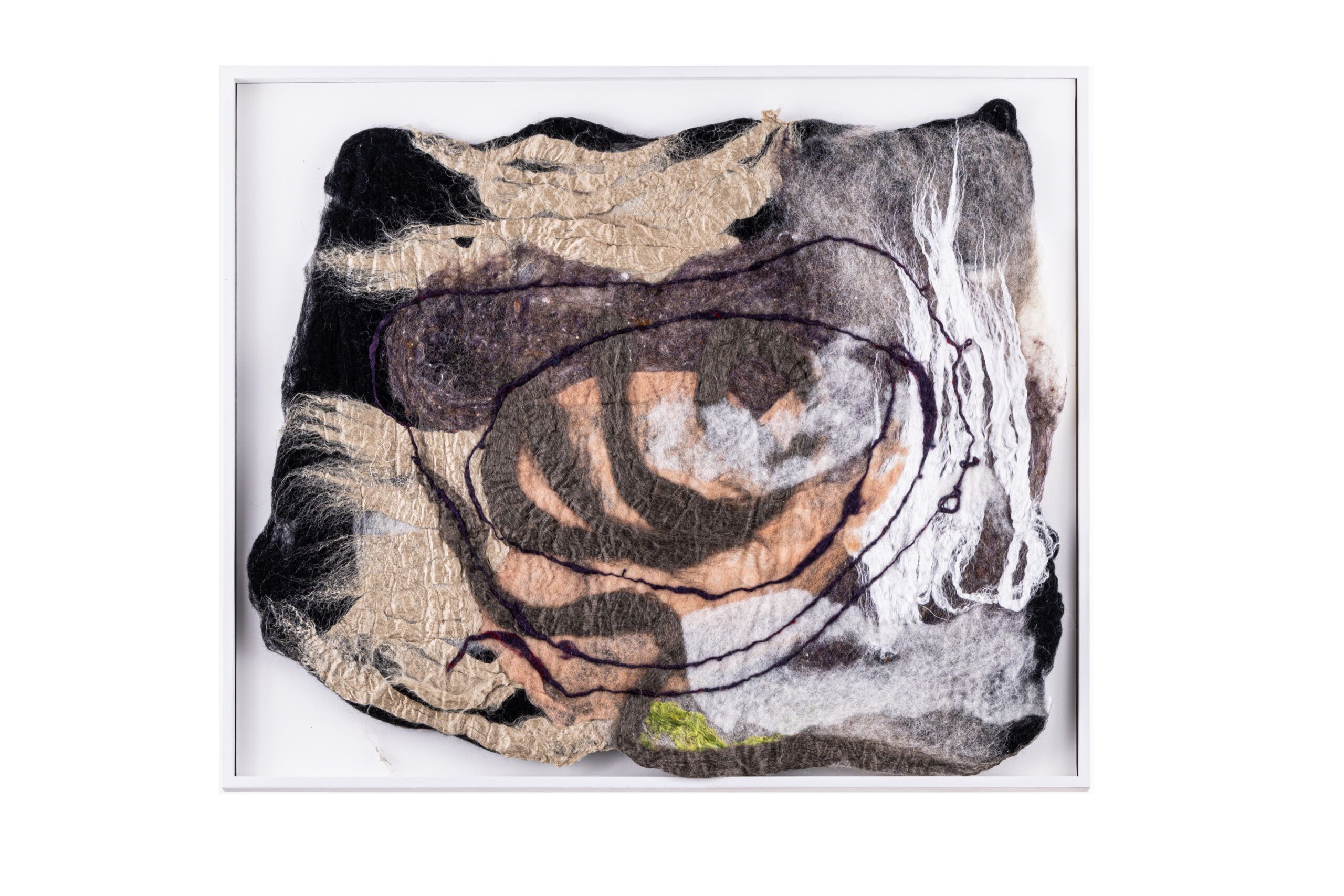
Guernica de la Ecologia Estudio en Color #4 is one of a series of studies for a monumental mural artwork paying tribute to Picasso’s famous painting Guernica (1937). Picasso’s work condemned the violence of the Civil War in Spain, while Jongstra’s studies and large-scale mural call attention to the ecological disaster threatening our existence. The dark colours and muted palette are a reference to Picasso’s monochromatic composition and, in this particular context, stand as a warning about the impact of climate change and intensive agriculture. The destruction of ecosystems would leave our world barren, drained of both colour and life. Is the bright yellow-green accent a symbol of life enduring in this barren landscape? Can we save it and rebuild a world of colour from it, or will we lose this too? The large-scale Guernica de la Ecologia travelled across Europe during the eponymous itinerant exhibition as a messenger of the urgent need for environmental action. In this light, we can consider the smaller study in the European Parliament’s Contemporary Art Collection a visual manifesto, urging us to engage in self-reflection, dialogue, and action towards a more sustainable future. Claudy Jongstra’s collaborations intersect with the world of fashion, gastronomy, and architecture, opening new avenues for wool as a contemporary artistic medium. Moreover, working with local farms, schools, and social programmes, the artist helps revitalize the community and reimagine their relationship to the environment. Jongstra’s art offers new perspectives on the processes and systems of textile production in a narrative which sees the resources, the land, and the people as tightly interwoven as her tapestries.
From the same artist
More artists from the following country:
Netherlands
Claudy JONGSTRA
Claudy JONGSTRAClick on the coloured dots and discover the european historical context
Browse the calendar and discover the european historical context
- 2013
- 2014
- 2015
- 2016
- 2017
- 2018
- 2019
- 2020
- 2021
- 2022
- 2023
- 2024
- 2025
- 2026
- 2027
- 2028
- 2029
- 2030
- 2031
- 2032
- 2033
-
2013
Acquisition programme
Acquisition programme of works of art from Croatia following the Bureau decision from 13 December 2006.
Enlargement Croatia
Croatia becomes the 28th member of the EU and newly-elected Croatian MEPs take their seats in the European Parliament.
-
2014
2014 European elections
The eighth European elections take place in 28 EU countries. The European People’s Party (EPP) retains the largest political group in Parliament, but new parties gain influence. Turnout remains largely at 2009 level.
-
2016
Brexit referendum
UK voters decide to support leaving the European Union in a closely-fought referendum called by UK Prime Minister David Cameron. The outcome of the referendum triggers the resignation of Cameron. His successor Theresa May pledges to take the UK out of the EU and initiates the process on 29 March 2017.
-
2017
Antonio Tajani
Antonio Tajani served as President of the European Parliament from 2017 to 2019.
-
2019
David Sassoli
David Sassoli served as President of the European Parliament from 2019 to 2022.
Value of culture
(…) the intrinsic value of culture and of artistic expression should always be preserved and promoted and that artistic creation is at the heart of cooperation projects. European Parliament legislative resolution of 28 March 2019 on the proposal for a regulation of the European Parliament and of the Council establishing the Creative Europe programme (2021 to 2027) and repealing Regulation (EU) No 1295/2013 (COM(2018)0366 – C8 0237/2018 – 2018/0190(COD))
2019 European elections
The European elections in May 2019 see about 51% of EU voters go to the polls, the highest turnout in 20 years. The centre-right European People’s Party and centre-left Social Democrats lose seats but remain the two largest groups in Parliament, while other centrist and liberal parties make gains.
-
2020
Brexit
After the European Parliament ratified the withdrawal agreement on 29 January, the UK leaves the EU about three and a half years after voters supported the move in a referendum.
As of 1 February, the number of EU member states is 27 and the term of office of UK MEPs ends. The number of MEPs is 705 (previously 751), as some of the UK seats are allocated to existing member states to reflect demographic changes, while others are kept in reserve for when another country joins the EU.
-
2021
Acquisition programme of works of art from Germany, Poland, Spain and Sweden following the Bureau decision from 25 November 2019
-
2022
European Year of Youth 2022
2022 is the European Year of Youth! A perfect opportunity to highlight the European youth’s important role in shaping a greener, more inclusive and digital future.
Acquisition programme of works of art from Czechia, Italy, Malta and Slovakia following the Bureau decision from 25 November 2019
Roberta Metsola
Roberta Metsola serves as President of the European Parliament since January 2022
-
2023
Croatia joins the euro area
Croatia is the 20th country to join the euro area, replacing the kuna with the euro as its currency. In order to be part of the euro area, a country has to fulfill a set of economic conditions, which include having a stable exchange rate and a low inflation rate. Seven EU countries still use their national currencies: Bulgaria, Czechia, Denmark, Hungary, Poland, Romania, and Sweden.
Acquisition programme of works of art from Cyprus, Estonia, Malta, Romania and The Netherlands following the Bureau decision from 25 November 2019
-
2024
Acquisition programme of works of art from Austria, Bulgaria, Croatia and Finland following the Bureau decision from 25 November 2019
European elections
The 2024 European Parliament election took place from 6 to 9 June 2024. This was the tenth parliamentary election since the first direct elections in 1979, and the first European Parliament election after Brexit.
-
2025
Acquisition programme of works of art from Denmark, Latvia and Slovenia following the Bureau decision from 25 November 2019